How to pack fragile items for moving
Updated September 5, 2026
An interstate move puts more handling events on your belongings than a local one — longer drives, and sometimes multiple loading transfers for less-than-truckload shipments. Fragile items need packing that accounts for that.
On this page
- The core method for packing fragile items safely
- Choosing the right cushioning material for fragile items
- Label fragile moving boxes clearly, on multiple sides
- Consider valuation coverage for your most valuable items
- Packing peanuts vs. paper: what each is actually for
- No single material is enough on its own
- Framed art, documents, and photos need a different approach than dishes and glassware
- Frequently asked questions
The core method for packing fragile items safely
- Wrap each item individually — never rely on loose paper filling the gaps between unwrapped items
- Use a box that's the right size, not oversized — too much empty space lets items shift and collide
- Cushion the bottom of the box before placing anything in, and top it off with more padding before sealing
- Never let two hard, fragile surfaces touch directly
- Shake the sealed box gently — if you feel or hear movement, open it and add more cushioning
Choosing the right cushioning material for fragile items
Packing paper works well for moderately fragile items and is cheaper and less bulky than bubble wrap. You will go through more of it than you expect, so buy extra. It is ideal for wrapping dishes, books with delicate covers, and decorative objects that need a buffer but not fortress-level protection. Reserve bubble wrap for genuinely delicate or valuable pieces — electronics, glass with thin walls, ceramics, or anything irreplaceable — where the extra protection is worth the added bulk and cost. Bubble wrap also makes sense for items with protruding parts that could snap under pressure, or for anything traveling long distance where the box may be shifted repeatedly in transit.
Label fragile moving boxes clearly, on multiple sides
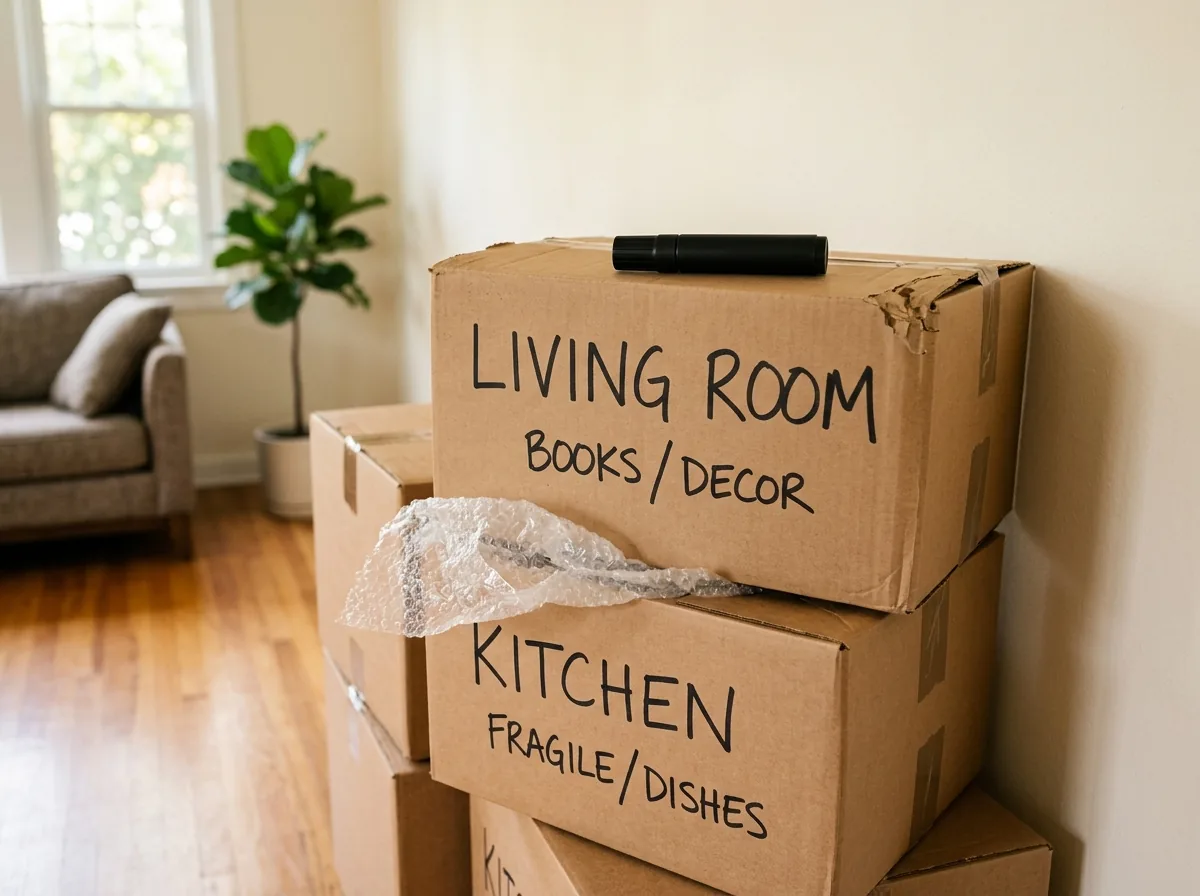
Mark fragile boxes on the top and at least two sides, not just one — boxes get stacked and turned during loading, and a label only on top is easy to miss. Add "this side up" arrows if the item's orientation matters. See our full labeling guide.
Would rather skip the packing?
Get quotes from full-service movers who pack for you — free, no obligation.
Consider valuation coverage for your most valuable items
Standard moving valuation is often minimal per pound, far below actual replacement value for something like fine china or electronics. For anything genuinely valuable or irreplaceable, review your options in our moving insurance guide before moving day, not after something breaks.
Packing peanuts vs. paper: what each is actually for
Packing peanuts aren't a substitute for wrapping an item directly — their job is filling the empty gaps around already-wrapped items so nothing has room to shift. As a side benefit, packing peanuts absorb some humidity, which offers a little extra protection for metal items and electronics traveling in the same box. Never leave a fragile box with open dead space; if you don't have enough peanuts or paper on hand, linens, t-shirts, and pillows work as gap-filling cushioning in a pinch. (Source: 1-800-PACK-RAT)
When a box holds multiple heavy, fragile pieces, place the heaviest ones in first — as long as each is individually wrapped — rather than trying to nestle heavier items in on top of lighter ones later. This keeps the center of gravity low and prevents crushing from above. Once the base layer is down, add a sheet of packing paper or thin cardboard as a shelf before placing the next tier. Fill any gaps with crumpled paper so nothing shifts when the box is tilted. Heavier items on top can also make the box awkward to lift and more likely to be dropped by movers who are working quickly.
No single material is enough on its own
Bubble wrap alone doesn't pad an item tightly enough to stop it shifting inside a box, and packing peanuts alone perform poorly as the main layer of protection — both work as a supplement to proper wrapping, not a replacement for it. Packing paper is flexible enough to wrap almost anything but still needs a cushioning material layered with it for real impact protection. In practice, the combinations that hold up best are wrapping paper first, then bubble wrap around genuinely fragile pieces, with peanuts or paper filling whatever gaps are left. If you do substitute newspaper for packing paper, double it up — it's thinner than commercial packing paper, and if it gets damp the ink can bleed onto whatever it's wrapped around. (Source: Move.org)
Framed art, documents, and photos need a different approach than dishes and glassware
Everything above works well for household breakables, but framed art, documents, maps, and photographs are a different category of fragile — flat, often irreplaceable, and vulnerable in different ways. Conservation guidance from the Northeast Document Conservation Center notes that paper-based items in transit are exposed to crushing, puncture, shock, vibration, and — over a long interstate haul — real swings in temperature and humidity that a short local move wouldn't produce. Ship these items flat whenever the box allows it; for anything too large to lie flat (posters, maps, oversized prints), rolling around a wide tube (at least 4 inches in diameter), wrapped first in a clean barrier layer, protects against creasing in a way that folding never will. Handle photographs and documents by the edges only, never across the printed or image surface. (Source: Northeast Document Conservation Center)
Get quotes for your move
Compare real mover reviews and get matched — free, no obligation.
Frequently asked questions
Yes — a long-haul truck covers far more miles, often with multiple loading transfers at consolidation points for less-than-truckload shipments, meaning more handling events than a local move's single load and unload.
Not always — packing paper is fine for moderately fragile items and is cheaper and less bulky; save bubble wrap for genuinely delicate or valuable pieces where the extra cushioning matters.
Consider it for anything irreplaceable or high-value — standard moving valuation coverage is often minimal per pound, not full replacement value. See our moving insurance guide for how coverage actually works.
Gently shake it before sealing — if you hear or feel movement, add more cushioning. A properly packed box shouldn't shift when tilted or lightly shaken.